NexusClaw
NexusClawEnterprise Applications & Digital Employee Platform

NexusClaw Lab / Trust Models

Trust Center | Six long-term capabilities

NexusClaw builds the platform around six long-term capabilities—security, compliance, privacy, reliability, performance, and scale—so enterprise controls, evidence, and operating outcomes stay on one governance chain.

SecurityCompliancePrivacyReliabilityPerformanceScale
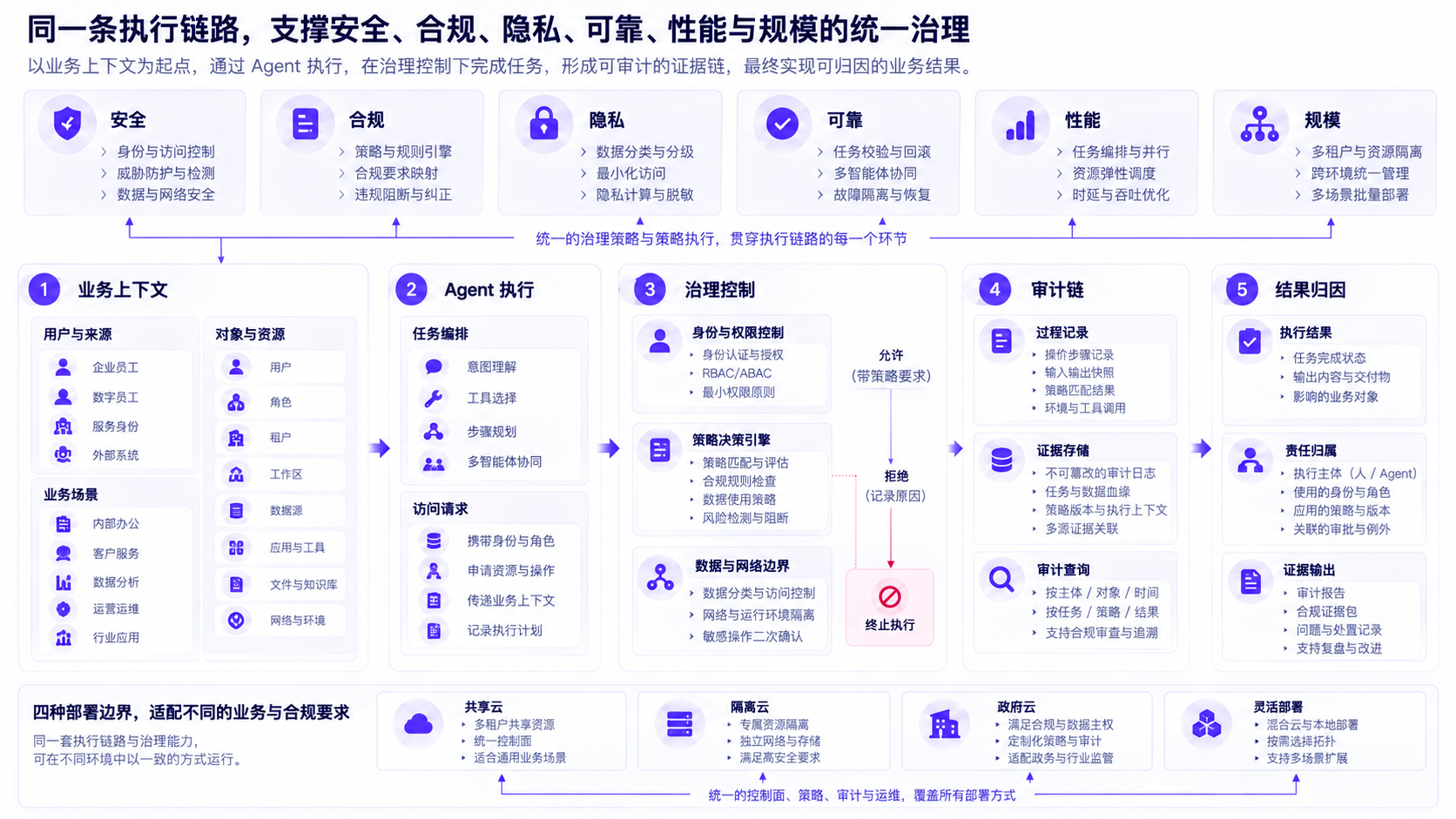
NexusClaw system architecture blueprint connecting channels, execution, governance, data, and deployment topologies
Decision evidence: One execution chain connects authorization, tools, human approval, outcome attribution, and deployment topology, giving the six capabilities a concrete operating surface.

Independent assessment pages

Each capability explains its principle, evidence, and boundary

Use the tabs above to open a dedicated page. Each page answers one buyer question and turns the mechanism into steps for evaluation, solution design, and acceptance.

Principle

What the system decides and when

Evidence

Which records let a customer review it

Boundary

What still needs project confirmation

Deployment posture

One governance method across four deployment boundaries

Shared cloud, isolated cloud, government cloud, and flexible deployment describe different combinations of data, network, model, key, and operations ownership.

01

Shared cloud

Shared platform resources provide the standard SaaS experience while tenant, identity, permission, data, and usage boundaries remain explicit.

For rapid launch and common workloads; data region, retention, and model policy are confirmed per project.

02

Isolated cloud

An independent runtime unit for teams with stronger network, resource, or data boundaries, assessed around dedicated resources, network, and keys.

For organizations that need a dedicated environment and clear operations ownership; isolation scope is agreed in the solution.

03

Government cloud

A dedicated trust path for government and public-sector workloads, covering residency, network zones, identity, audit, supply chain, and continuity.

Government cloud is not a universal certification; region, access, compliance requirements, and provider qualifications are accepted per project.

Explore details →
04

Flexible deployment

Combine managed SaaS, hybrid deployment, private runtime, and customer-side models around data, model, network, and operations ownership.

Set the boundary first, then size resources and responsibilities for model, backup, upgrade, and rollback.

Explore details →

Boundary statement

Public language must be backed by project evidence

A deployment mode is not a compliance certification and does not create a data-residency, risk, or continuity program by itself. A formal project accepts region, network, identity, logs, models, backup, incident, and ownership controls against an evidence checklist.

Start a trust assessment with your data boundary and business goals

We start with the deployment boundary, then align the six capabilities, evidence direction, and acceptance path for go-live.