
Data residency
Where business data, logs, and backups live is set by project policy and written into the proposal.
Government Cloud
We run NexusClaw in a dedicated environment for government customers. Where data lives, how the network is zoned, who gets access, and how actions are logged are all confirmed item by item at the proposal stage.
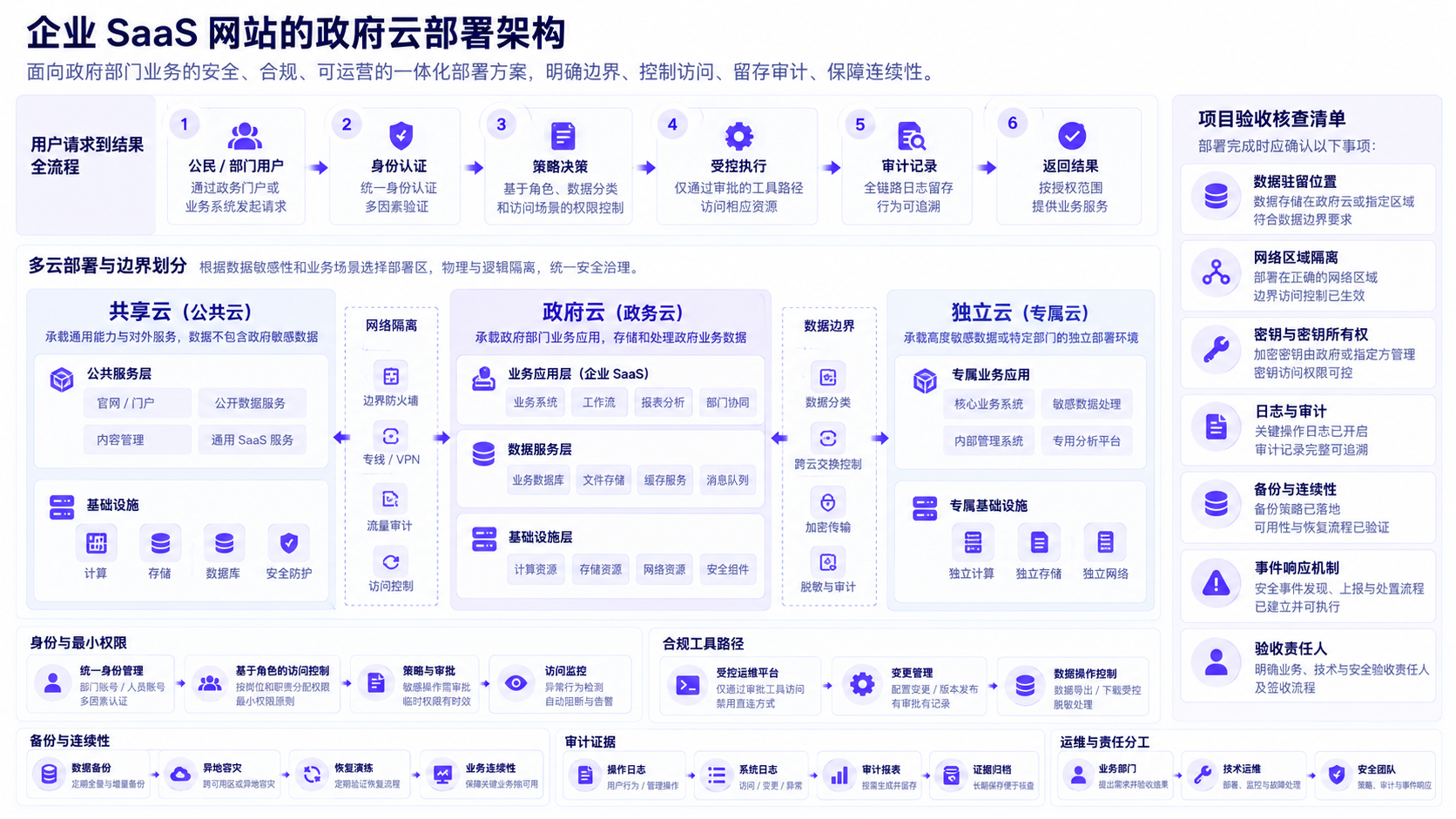
Where business data, logs, and backups live is set by project policy and written into the proposal.
Public entry, applications, data services, and model connections deploy in separate, inspectable zones.
Permissions follow organization and role; high-risk actions need approval and get reviewed on a schedule.
Access, calls, approvals, and outcomes are logged, so any issue traces back to a person and a step.
Images, dependencies, models, and keys are verified at the source; releases and rollbacks are recorded.
Backups, failover, and incident drills run on schedule, against verifiable recovery-time targets.
Government cloud boundary
Provider qualifications, deployment region, network entry, identity source, log retention, model and key provenance, backup policy, incident handling, and day-to-day operations ownership — each of these gets walked through during evaluation. NexusClaw provides the platform and the supporting evidence so acceptance can be completed.
Whether a project satisfies specific control sets or procurement requirements depends on region, cloud environment, and data classification — the authority and final acceptance criteria have the final say.
Data and log inventory
Network and identity matrix
Change and supply-chain records
Continuity and incident exercises
Public compute in 3–5 years
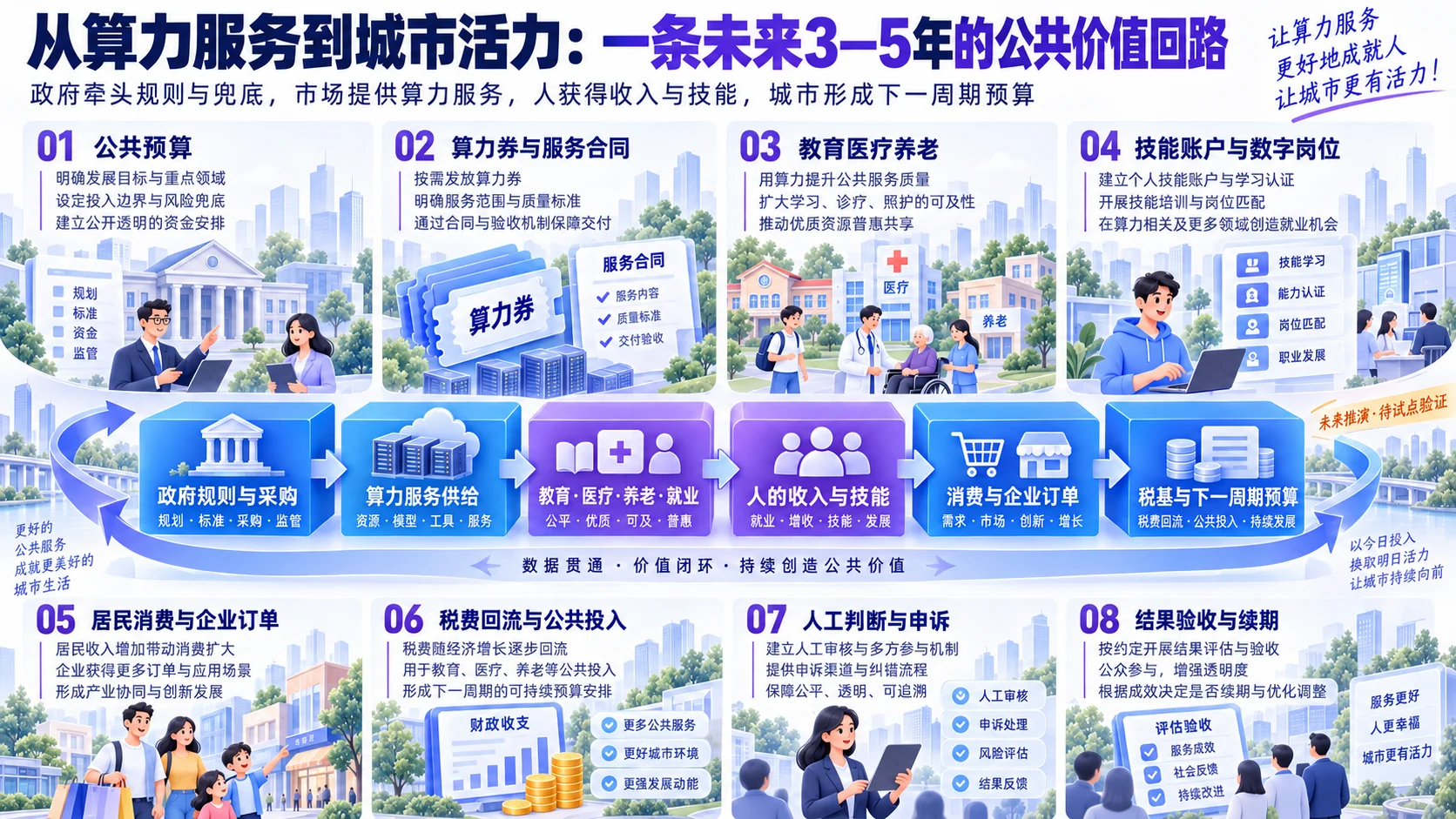
“Land fiscal policy” is a public-discussion term whose official fiscal records use state-owned land-use-right transfer revenue and government-fund budgets. This article uses “compute service fiscal policy” as a 3–5 year working term: if AI makes continuous computation part of employment, production, and city operations, could government set the rules and purchase accepted compute services so education, health, care, and income pathways keep working? It is not a new tax or current fiscal account. It is a hypothesis that must be piloted, metered, and held accountable.
Evidence chain
Blue is public fact, purple is this article’s inference, and orange remains for project owners and human decisions.
Observed · Official documents
East Data West Computing established eight hubs and ten clusters; later guidance added unified measurement, billing, trading, and settlement.
NDRC / National Data Administration · 2022–2024
Observed · Local examples
Beijing documents a contract-to-voucher settlement chain, while Shanxi and Nanjing provide other local subsidy or first-transaction examples.
Official Beijing, Shanxi, and Nanjing documents · 2023–2025
Inference · To be tested
It is not a new tax or current fiscal account. It is a 3–5 year discussion framework for buying, metering, and accepting compute services.
Research framework based on public documents · not a policy proposal
2022
Eight hubs and ten clusters; compute was elevated alongside water, electricity, and gas.
2023/24
Guidance introduced cross-region scheduling and unified measurement, billing, trading, settlement, and allocation.
2023–25
Beijing, Shanxi, and Nanjing published voucher, subsidy, or first-transaction examples.
2025
Employment risk, reskilling, public governance, fiscal support, and procurement entered one policy frame.
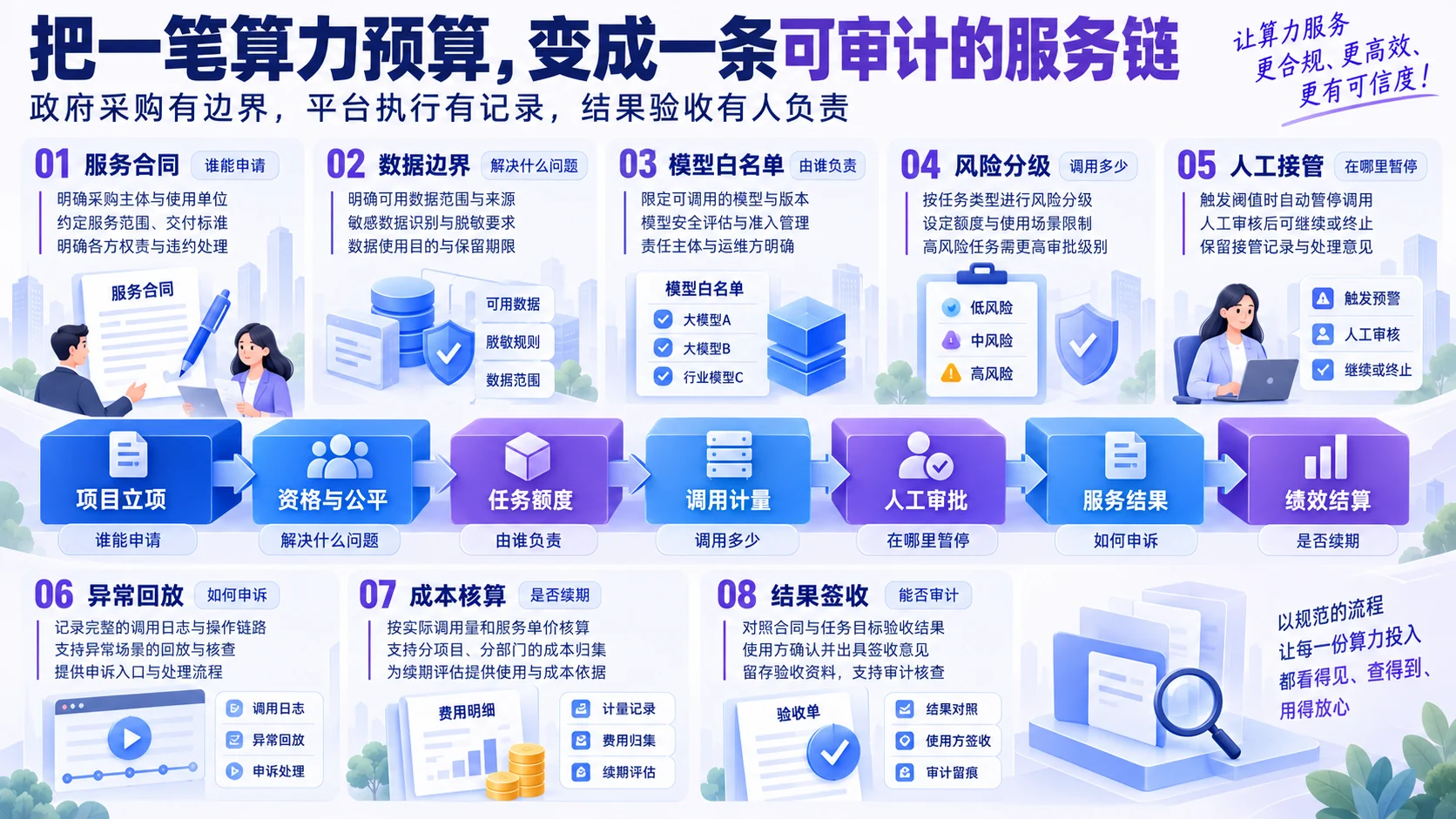
How one budget runs one real task
These four layers do not set policy; they put budget, calls, human decisions, and outcomes on one chain for project owners to pilot, review, and accept.
PICK A REAL TASK
Say which real service the budget should improve before using abstract policy language.
Task examples
Reskilling, frontline follow-up, job matching, emergency duty
Budget guardrails
Service population, dates, quota ceiling, and human owner
Result sign-off
Which task received the spend, who it served, and who accepted the result
ACCESS ALLOCATION
Set how much it may use, how long it lasts, and when it must stop.
How much compute
Task type, model tier, concurrency, region, and latency
How to cap it
Quota, rate, expiry, model allowlist, and call limits
What to record
Every call records identity, task, cost, and allowance consumption
GOVERNED EXECUTION
Compute must finish a real piece of work with a named owner, not stop at usage volume.
What it connects to
Business object, digital employee, tools, and approval points
Where it must stop
Authority, risk tier, takeover, retry, and refusal paths
How to review it
Task state, tool actions, human decisions, and exceptions are replayable
OUTCOME SETTLEMENT
The next budget cycle should follow results and cost, not promotional numbers.
What result to check
Task completion, service latency, training results, and human intervention
When to continue
Cost accounting, performance thresholds, review cycles, and exit criteria
What to hand over
Compute use, outcome quality, and public goals appear in one report
A task closes only when we know who runs it, how much compute it uses, where a person must approve, and what result is delivered
Without these records, nobody can tell whether the spend was worth it.
From infrastructure to public tasks
The article, From Land Finance to Compute-Service Fiscal Policy, reviews public policy documents and local pilots, plus our own three-to-five-year outlook. It is included here so compute investment and service outcomes can be read together when evaluating a government cloud project.
01
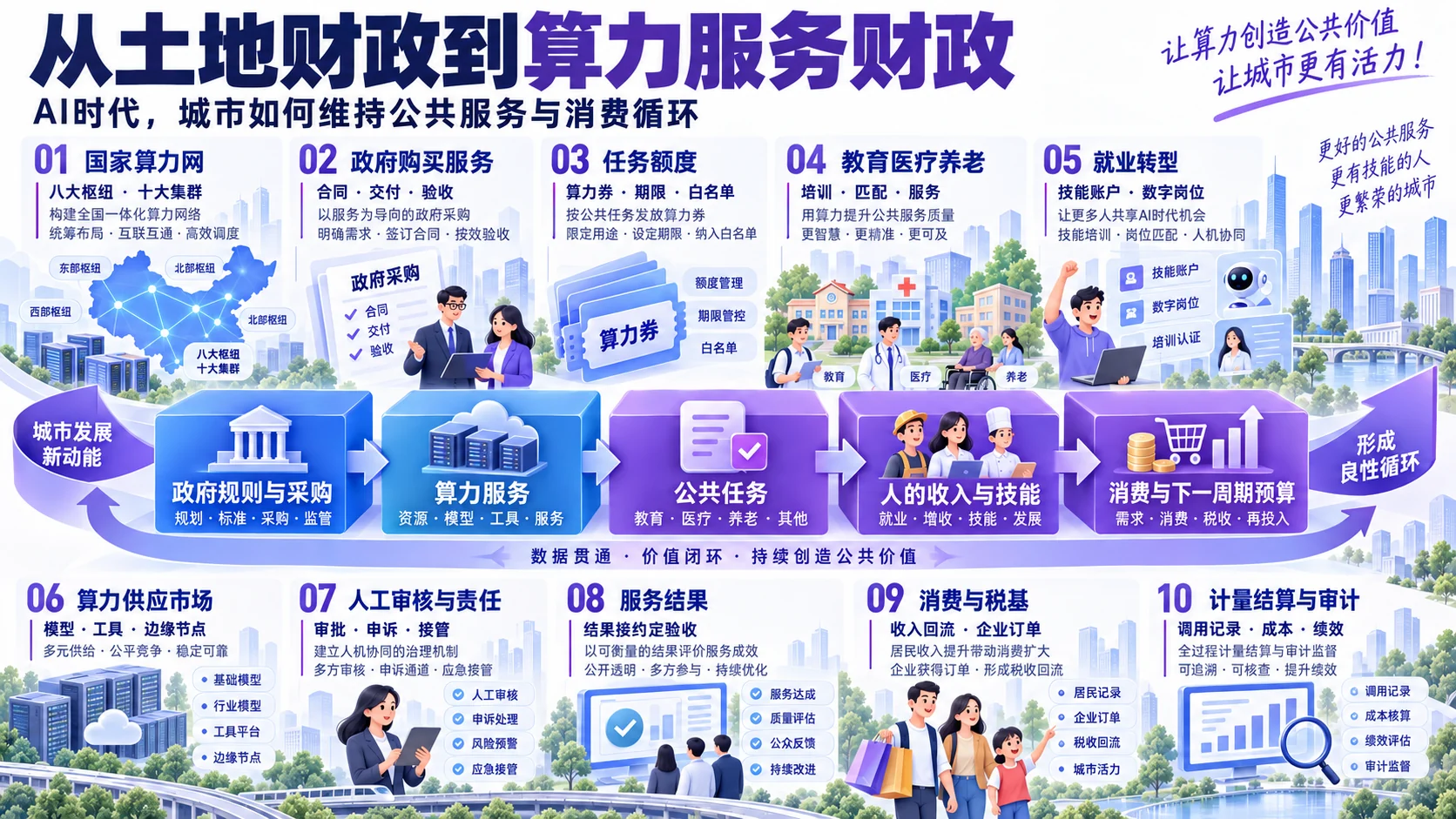
In its 2022 explanation of East Data West Computing, the National Development and Reform Commission said compute resources were being elevated to the level of essential resources such as water, electricity, and gas. The program established eight national computing hubs and ten data-center clusters for cross-regional coordination. “Compute as infrastructure” is therefore part of a national engineering and regional-development vocabulary, not only a vendor slogan.
The six-department action plan that followed put compute, network transport, storage, and application enablement into one infrastructure framework. Its targets covered compute scale, intelligent-compute share, and application benchmarks in key industries. Compute is moving from a data-center metric to a resource-allocation question shared by industry, energy, networks, and public services.
02
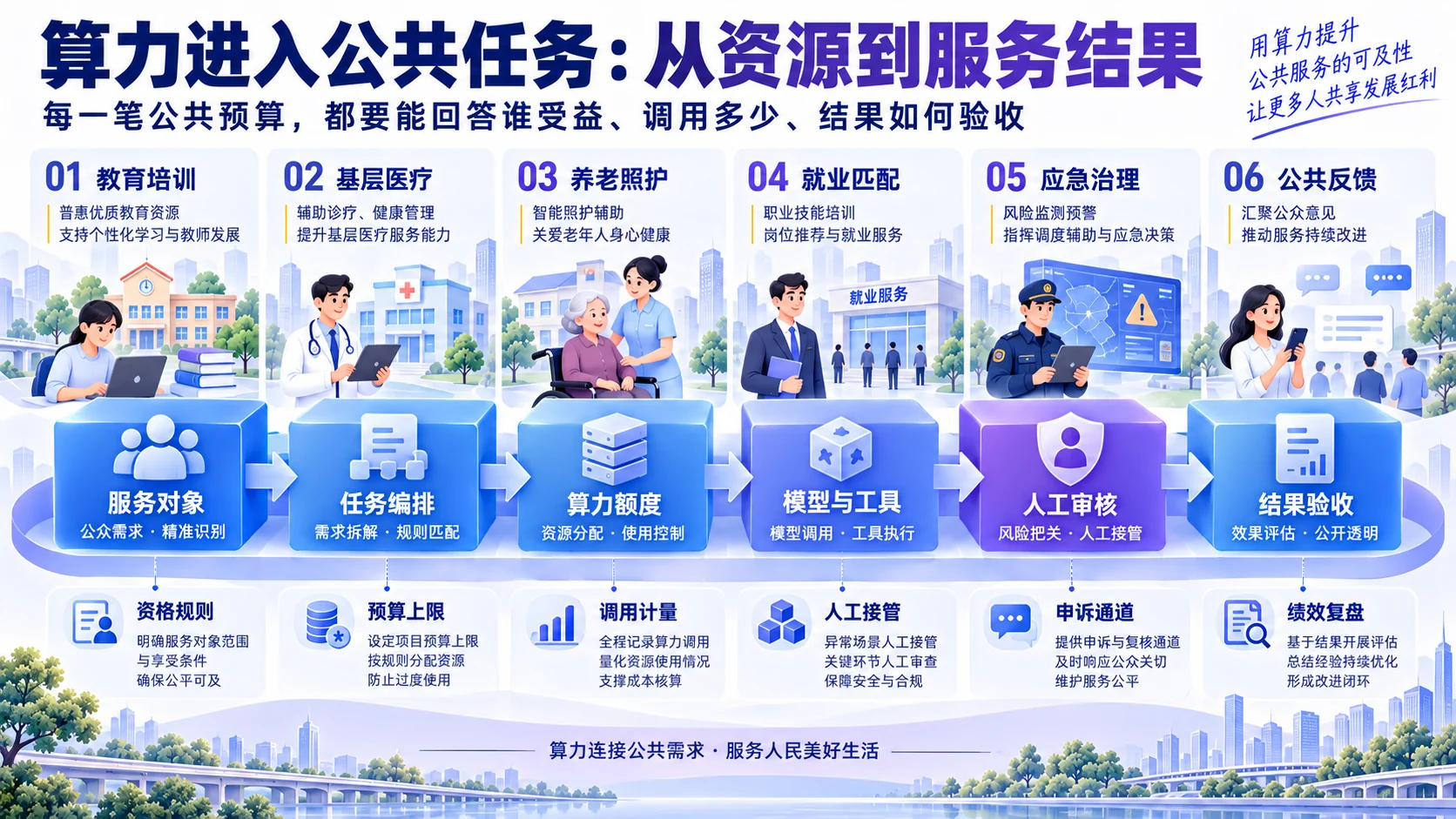
The NDRC’s employment interpretation of the AI Plus agenda describes both sides of the transition: AI may replace some routine work while creating new roles, intelligent agents, and more flexible human-machine collaboration. For a small product company, the practical question is not to write employment policy for public agencies. It is to understand whether future projects will connect training, employment services, or frontline follow-up to metered compute and tools.
That narrows the product question to one operating chain: who starts a service, how much compute it uses, where a person must decide, and what result is delivered. Those records let a pilot team compare approaches and let a supplier be clear about the part it owns.
03
“Compute-service fiscal policy” is a useful working name for a possible two-layer arrangement. The first layer is the infrastructure already visible in policy: hubs, networks, storage, energy, and security. The second layer is a hypothesis that some future public-service projects may purchase or allocate metered compute and keep task, cost, and outcome records together.
This is not a distribution plan proposed by NexusClaw, and it is not a current policy label. Compute vouchers, public pools, and task quotas are simply examples that a pilot owner might compare. The actual approach would depend on the project goal, budget source, procurement rules, and service population.
04
On a three-to-five-year horizon, the question is no longer only how many compute centers a city builds. It is whether continuous computation can become continuous service. One possible loop is: government buys accepted compute services for education, health, care, and employment transition; those tasks create training, digital roles, and service income; household income returns through consumption and business orders; taxes and public budgets support the next service cycle. This is a resilience scenario, not a promise about future revenue.
In that loop, government sets fairness and safety rules, bounds budgets, purchases essential capacity, protects people who cannot pay, and requires auditable outcomes. Model makers, compute suppliers, and software companies provide replaceable market supply. Business departments and people retain key judgment and appeal rights. A city does not need to own every model, but it does need to answer where public compute was used, whom it helped, and whether it produced a result.
A future pilot should test four signals: do people gain a new income or skills pathway, do public services reduce waiting and repetitive work, will enterprises keep paying for results, and can the next budget renew by task performance rather than machine count? Only if these signals hold together can compute-service fiscal policy move from a blueprint to a durable city operating mechanism.
05
If a local authority, institution, or enterprise decides to pilot this, a bounded operating chain is a safer starting point than a broad program. Examples could include answering and grading in vocational training, reminders and record preparation in frontline follow-up, or assisted job matching. Define inputs, allowed tools, human handoff points, and outcome fields before deciding whether to allocate compute.
East Data West Computing provides an infrastructure context; each project still needs to document where data comes from, who operates the service, and who takes over when something fails. Whether cross-region scheduling fits should follow data boundaries, latency, cost, and procurement conditions rather than a website claim.
A review can start with simple questions: was the task completed, did service response improve, where did people take over, what did each call cost, and who signed off the result? Those questions are closer to pilot continuation than a headline about racks built.
06
First, write down who can enter the task chain. Second, define what the allowance can and cannot do. Third, decide how calls and human intervention are measured. Fourth, name the business owner who accepts the result. This is not a new theory for public agencies; it is one acceptance sheet that buyers, operators, and suppliers can read together before a pilot starts.
The final shape must follow the project’s legal, budget, procurement, and data requirements. NexusClaw can record tasks, identities, calls, approvals, and outcomes so a team can review the run. Policy goals, funding decisions, and public accountability remain with the responsible institutions.
07
NexusClaw does not set fiscal policy or present compute-service fiscal policy as an existing institution. If a future project needs an operating record, we can provide one part of the toolchain: connect the task, identity, approved model, allowance, approval, human takeover, cost, and outcome in one traceable chain.
The value is concrete: a project team can review who called what, where the system stopped, where a person took over, and what result was delivered. Whether the project should continue or expand is for the project owner to decide against its own rules and results.
Evidence base
These sources cover national compute infrastructure programs, government service-procurement rules, and local compute-voucher pilots. How a specific project is built and funded remains with the project authority.
NDRC · 2022
Explains the national project and its framing of compute alongside water, electricity, and gas.
Open sourceNational Data Administration · 2024
Covers key infrastructure, cross-region scheduling, unified measurement, billing, trading, settlement, and on-demand services.
Open sourceMIIT · 2023
Sets policy targets across compute, network, storage, and key-industry applications; targets are not current performance.
Open sourceNational Data Administration · 2025
Shows that grid connection, resource scheduling, multidimensional billing, efficiency, and monitoring are entering technical discussion.
Open sourceState Council · 2025
Covers livelihoods, employment, public governance, fiscal support, and government procurement.
Open sourceNDRC · 2025
Discusses job transition, skills training, employment services, and social protection.
Open sourceMOF · 2020
Requires payment by service quantity and quality, budget constraints, monitoring, ledgers, and performance review.
Open sourceMOF · 2025
Uses the official account “state-owned land-use-right transfer revenue”; land fiscal policy is a public-discussion term.
Open sourceBeijing Municipal Commission of Economy and Information Technology · 2023
Documents a local contract, invoice, delivery proof, verification, and settlement chain; it is not a national policy.
Open sourceBeijing public resources platform · 2024
A government procurement notice connecting compute-center operations to urban-service scenarios; budget is not final performance.
Open sourceNanjing Data Bureau · 2025
A local first-transaction news item showing a service-market sample, not a mature national market.
Open source"Compute-service fiscal policy" is a discussion framework we derived from public sources. It is not current policy, and it carries no commitment.
Bring your data classification, region, network, identity, and continuity requirements. We will assess the solution from the boundary outward.